October 16, 2017

Slideshow: 2017 SSRL/LCLS Users’ Meeting

About 400 people attended the annual conference and workshops for scientists who conduct experiments at SLAC’s light sources.

By Dawn Harmer and Amanda Solliday

This year’s SSRL/LCLS Annual Users' Meeting brought together nearly 400 researchers who conduct experiments at Stanford Synchrotron Radiation Lightsource (SSRL) and the Linac Coherent Light Source (LCLS), including 90 participants in the concurrent High-Power Laser workshop.The meeting was held at the Department of Energy’s SLAC National Accelerator Laboratory Sept. 27-29.
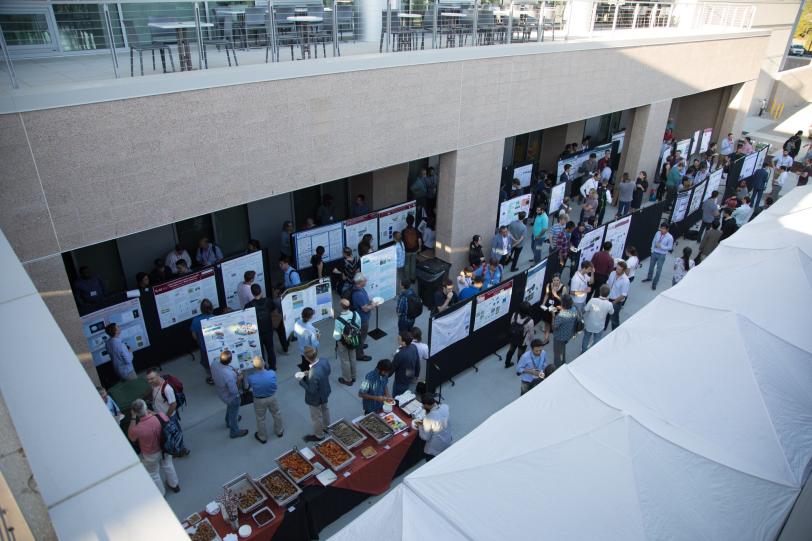
Birds-eye view of the poster session
The second annual Joe Wong Outstanding Poster Award Session was held at the 2017 SSRL/LCLS Users’ Meeting. (Dawn Harmer/SLAC National Accelerator Laboratory)

As DOE Office of Science User Facilities, SSRL and LCLS are open to scientists around the world for experiments that explore matter and processes with extremely bright X-rays.

The meeting consists of presentations and workshops where participants share and discuss facility capabilities and the latest areas of research. The Melvin P. Klein Scientific Development Award, Farrel W. Lytle Award, William E. and Diane M. Spicer Young Investigator Award and LCLS Young Investigator Award were presented at the meeting, as well as the second annual Joe Wong Outstanding Poster Awards.

The 2017 meeting organizers were Christoph Bostedt of Argonne National Laboratory, who is vice chair of the LCLS Users’ Executive Committee; David Bushnell of Stanford University, the SSRL Users’ Executive Committie vice chair; and SLAC scientists Axel Brachmann, Sergio Carbajo and Dimosthenis Sokaras.
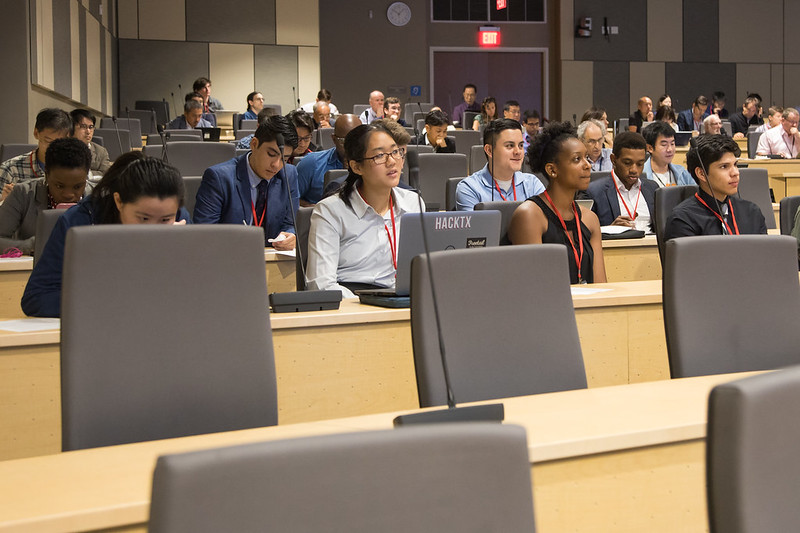
2017 Users’ Meeting


Contact

For questions or comments, contact the SLAC Office of Communications at communications@slac.stanford.edu.

Dig Deeper

Related stories

News Brief

Finding provides insights into design for heat-resistant fusion chamber. 

Bright white and pink beam of light striking an orange textured surface, with clustered glowing orange spheres on the left against a dark background.
News Brief

In a SLAC-led study, four laboratories collaborated to ensure reproducibility in AI training data to predict new catalysts for future fuel production.

Graph against blue background representing results from experiments
News Release

Researchers from the SLAC-Stanford Battery Center join USC in a project to help secure the U.S. supply of critical minerals.

Illustration of battery waste, AI agents and critical minerals
News Brief

Finding provides insights into design for heat-resistant fusion chamber. 

Bright white and pink beam of light striking an orange textured surface, with clustered glowing orange spheres on the left against a dark background.
News Brief

In a SLAC-led study, four laboratories collaborated to ensure reproducibility in AI training data to predict new catalysts for future fuel production.

Graph against blue background representing results from experiments
News Release

Researchers from the SLAC-Stanford Battery Center join USC in a project to help secure the U.S. supply of critical minerals.

Illustration of battery waste, AI agents and critical minerals
News Brief

Using the powerful LCLS X-ray laser, researchers at SLAC have directly imaged for the first time how molecules rearrange during a chemical reaction controlled...

Illustration of probe-pump-dump for imaging
Feature

The lab’s contributions to the national AI initiative are bolstered by its breakthrough scientific tools, unprecedented data and unique partnerships that help illuminate nature...

Sunrise over SLAC campus
News Brief

By adjusting the heating process when making lithium-ion cathodes, the team created batteries that retained nearly 93% of their energy after 500 cycles. 

Two line graphs with time axis, yellow arrow between them, 3D gray sphere with wedge beside yellow crystal, yellow-coated sphere on right, bottom panels showing uniform yellow-orange circular heat map and less-cracked orange circle, labeled "Uniform reaction, Homogeneous Ni states, Less cracked."